Press release
English
English (pdf)
Swedish
Swedish (pdf)

6 October 2026
The Royal Swedish Academy of Sciences has decided to award the Nobel Prize in Physics 2026 to
Francis Halzen
University of Wisconsin–Madison, USA
“for decisive contributions to the IceCube Neutrino Observatory and the discovery of high-energy neutrinos of astrophysical origin”
Elusive particles from the universe captured at the South Pole
Francis Halzen realised that ice at the South Pole could be used to track particles known as neutrinos. His vision and scientific leadership have been fundamental for the IceCube Neutrino Observatory – a cubic kilometre of ice that is equipped with light sensors. Using IceCube, researchers can capture neutrinos from extremely energy-rich processes in the distant universe.
Neutrinos are everywhere, but they do not make themselves known. They pass all the way through the Earth and through our bodies without us noticing. Very rarely, a single neutrino will interact with an atomic nucleus, which makes it possible for someone with the right equipment to discover them.
Scientists have long known that the cosmos contains natural particle accelerators, which fire out particles with energies up to a million times more than can be achieved in laboratories on Earth. Much about these sources is mysterious: what are they, where are they, and what are the main processes inside them?
Neutrinos with extremely high energies are created in the same environments as other types of particles. However, unlike other particles, neutrinos reach us without changing direction or losing energy. This means they can provide information that is not available in any other way.
Francis Halzen first presented his vision for capturing neutrinos at the South Pole in 1988. When a neutrino collides with an atomic nucleus, it produces a flash of light that can be tracked by sensors in the clear glacial ice. The South Pole’s ice has many advantages, as it is free from various types of interference and the area is geologically stable, with no earthquakes. Halzen and his idea soon gained the support of other researchers and, just a few years later, preliminary testing was conducted on sensors in ice.
Cosmic neutrinos with extremely high energies are very rare, so an enormous volume of ice is needed to observe an adequate number of collisions. IceCube covers an entire cubic kilometre and was finished in 2011. Researchers soon discovered the first high-energy neutrinos and, a few years later, could publish their discovery of neutrinos that must originate far outside our solar system. The search for the universe’s neutrino sources could begin in earnest.
“Francis Halzen has led an international team of researchers and engineers who have provided us with a fantastic instrument. His tenacity and scientific vision has paved the way for a new kind of astronomy,” says Mark Pearce, Chair of the Nobel Committee for Physics.
The neutrino interactions that are continuously collected by IceCube will provide researchers with novel knowledge about the violent settings in which high-energy neutrinos can be created – and could even reveal previously unknown cosmic phenomena.
Illustrations
The illustrations are free to use for non-commercial purposes. Attribute © Johan Jarnestad/The Royal Swedish Academy of Sciences
Illustration: Nobel Prize in Physics 2026 (jpg)
Illustration: An observatory in the ice (jpg)
Illustration: Messengers from space (jpg)
Read more about this year’s prize
Popular science background: Ice at the South Pole reveals cosmic particle accelerators (pdf)
Scientific background to the Nobel Prize in Physics 2026 (pdf)
Francis Halzen, born 1944 in Tienen, Belgium. PhD 1969 from KU Leuven, Belgium. Professor at University of Wisconsin–Madison, USA.
Prize amount: 12 million Swedish kronor.
Further information: www.kva.se and www.nobelprize.org
Press contact: Eva Nevelius, Press Secretary, +46 70 878 67 63, eva.nevelius@kva.se
Experts: Ulf Danielsson, +46 70 314 10 86, ulf.danielsson@kva.se and Mark Pearce, +46 70 166 74 86, pearce@kth.se, members of the Nobel Committee for Physics.
The Royal Swedish Academy of Sciences, founded in 1739, is an independent organisation whose overall objective is to promote the sciences and strengthen their influence in society. The Academy takes special responsibility for the natural sciences and mathematics, but endeavours to promote the exchange of ideas between various disciplines.
Nobel Prize® is a registered trademark of the Nobel Foundation.
---
Popular information
---
Scientific background
Laureates
Wikipedia: Francis Halzen
---
- No Electric Charge: They are electrically neutral, meaning they do not feel the electromagnetic force. [1, 2, 3]
- Weak Interaction: They only interact with other matter via gravity and the weak nuclear force. Because the weak force has a very short range and gravity is exceptionally weak at the subatomic scale, they pass right through solid objects—including planets, stars, and human bodies—virtually unimpeded. [1, 2, 3]
- Three Flavors: There are three known types (or "flavors") of neutrinos:
- The Sun: Nuclear fusion reactions in stellar cores create a massive stream of solar neutrinos. Trillions pass through your body every second. [1, 2]
IceCube
Detector
IceCube, the South Pole neutrino observatory, is a cubic-kilometer particle detector made of Antarctic ice and located near the Amundsen-Scott South Pole Station. It is buried beneath the surface, extending to a depth of about 2,500 meters. A surface array, IceTop, and a denser inner subdetector, DeepCore, significantly enhance the capabilities of the observatory, making it a multipurpose facility.

IceCube is the first gigaton neutrino detector ever built and was primarily designed to observe neutrinos from the most violent astrophysical sources in our universe. Neutrinos, almost massless particles with no electric charge, can travel from their sources to Earth with essentially no attenuation and no deflection by magnetic fields.
The in-ice component of IceCube consists of 5,160 digital optical modules (DOMs), each with a ten-inch photomultiplier tube and associated electronics. The DOMs are attached to vertical “strings,” frozen into 86 boreholes and arrayed over a cubic kilometer from 1,450 meters to 2,450 meters depth. The strings are deployed on a hexagonal grid with 125 meters spacing and hold 60 DOMs each. The vertical separation of the DOMs is 17 meters.
Eight of these strings at the center of the array were deployed more compactly, with a horizontal separation of about 70 meters and a vertical DOM spacing of 7 meters. This denser configuration forms the DeepCore subdetector, which lowers the neutrino energy threshold to about 10 GeV, creating the opportunity to study neutrino oscillations.
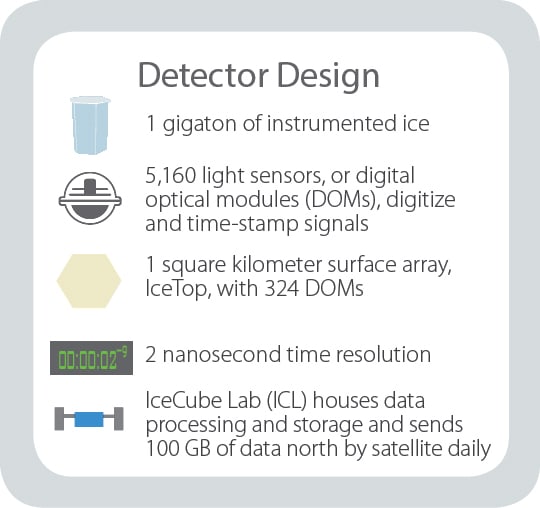
IceTop consists of 81 stations located on top of the same number of IceCube strings. Each station has two tanks, each equipped with two downward facing DOMs. IceTop, built as a veto and calibration detector for IceCube, also detects air showers from primary cosmic rays in the 300 TeV to 1 EeV energy range. The surface array measures the cosmic-ray arrival directions in the Southern Hemisphere as well as the flux and composition of cosmic rays.
Developments in neutrino astronomy have been driven by the search for the sources of cosmic rays, leading at an early stage to the concept of a cubic-kilometer neutrino detector. Cosmic rays, which consist mainly of protons, are the highest energy particles ever observed, with energies over a million times those reached by today’s particle accelerators on Earth.
AMANDA, the Antarctic Muon and Neutrino Detector Array, was built as a proof of concept in the mid 1990s and demonstrated that the extremely clear Antarctic ice was suitable for detecting energetic neutrinos. IceCube, the only cubic-kilometer neutrino detector constructed to date, was completed in December 2010, only six years after the deployment of the first string at the South Pole.
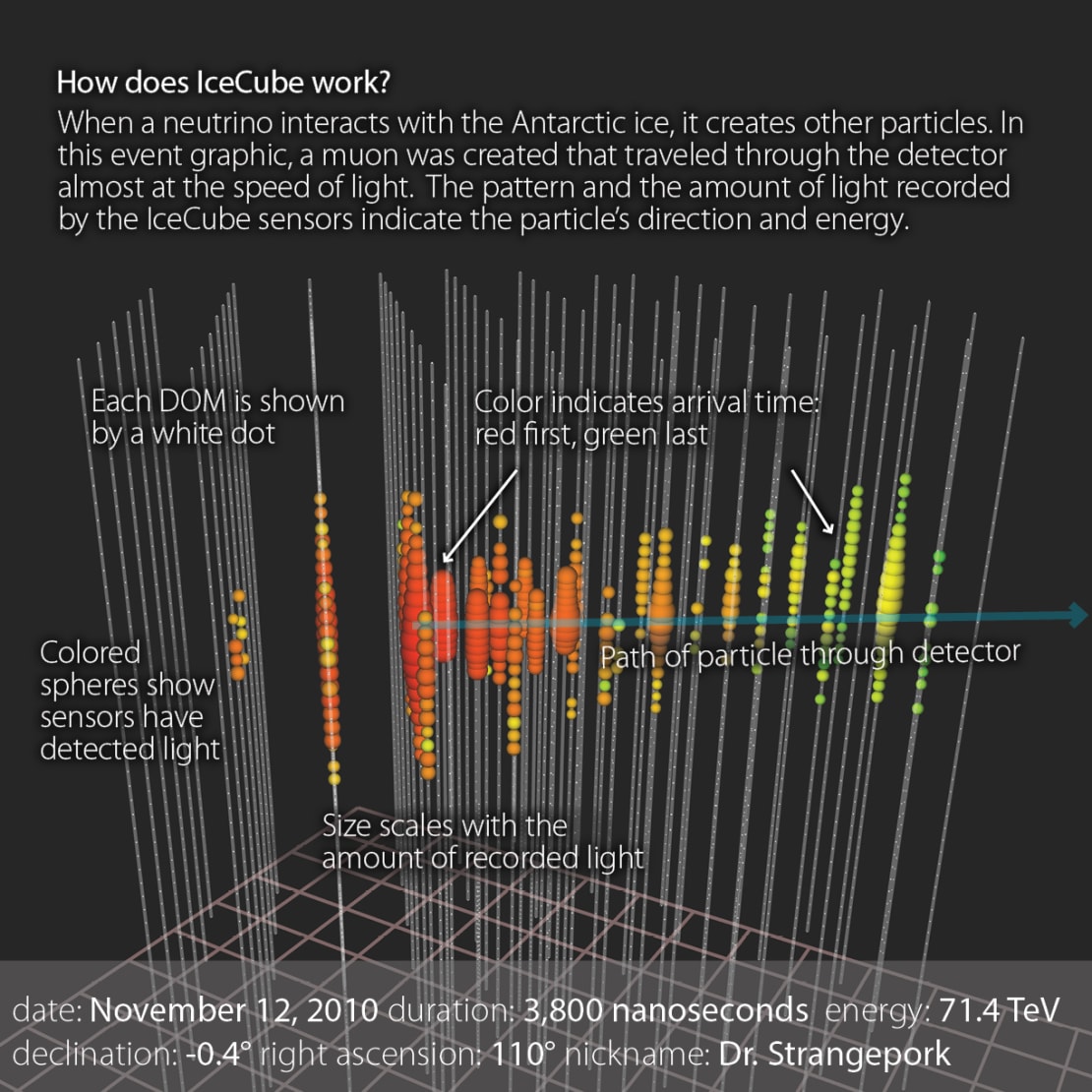
Neutrinos are not observed directly, but when they happen to interact with the ice they produce electrically charged secondary particles that in turn emit Cherenkov light, as a result of traveling through the ice faster than light travels in ice.
The IceCube sensors collect this light, which is subsequently digitized and time stamped. This information is sent to computers in the IceCube Lab on the surface, which converts the messages from individual DOMs into light patterns that reveal the direction and energy of muons and neutrinos.
The IceCube Neutrino Observatory was built under a National Science Foundation (NSF) Major Research Equipment and Facilities Construction grant, with assistance from partner funding agencies around the world. The NSF Office of Polar Programs supports the project with a Maintenance and Operations (M&O) grant. The University of Wisconsin–Madison is the lead institution, coordinating data-taking and M&O activities. The international IceCube Collaboration, with more than 40 institutions worldwide, is responsible for the scientific research program.
Construction
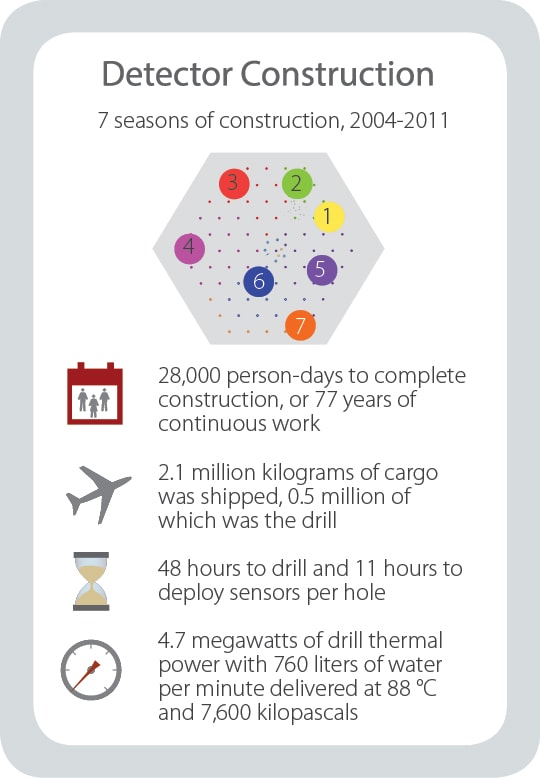
On December 18, 2010, just after 6 pm New Zealand time, the last of IceCube’s 86 strings was lowered into the Antarctic ice. Seven austral summers of construction had come to an end, and IceCube was completed a decade after the collaboration submitted the proposal.
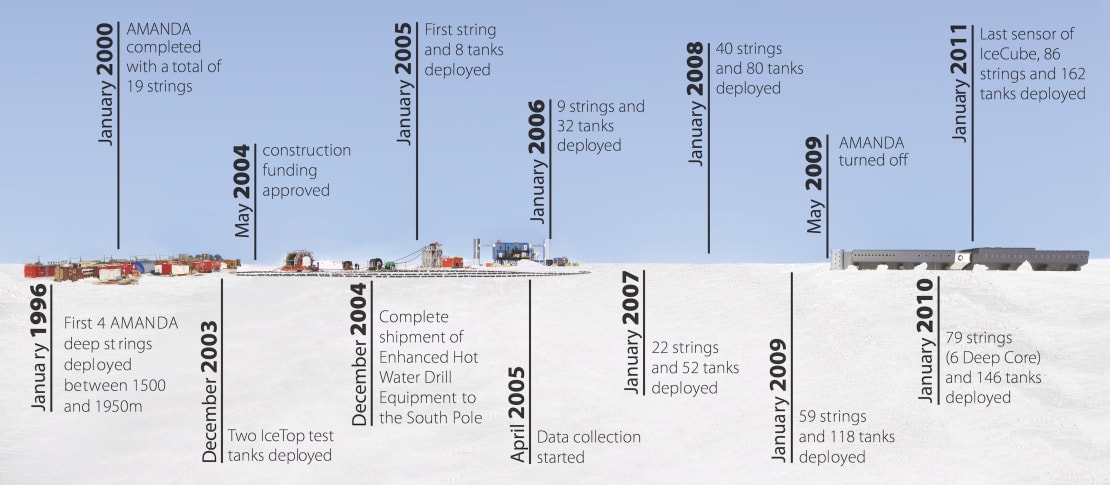
Dedicated teams melted 60-centimeter diameter holes to a depth of 2,450 meters, deployed sensors, and commissioned strings from November to February each year from 2004 until 2011. Deployment specialists spent 11 hours on average to expertly connect sensors to a cable and lower them into the water-filled holes, which eventually refroze. In seven seasons, 86 holes in all were drilled and instrumented.
The drill was designed by the IceCube project and built at the UW Physical Sciences Lab. The high-pressure hose and nozzle delivered hot water that melted through the ice at record speeds, about 2 meters per minute, down to depths of 2,450 meters. A separate drill was designed and deployed to advance through the firn layer, the top 50 meters of compacted snow where hot water drilling is not efficient. Together the two drills were able to consistently produce almost perfect vertical holes ready for deployment of instrumentation at a rate of one hole every two days.
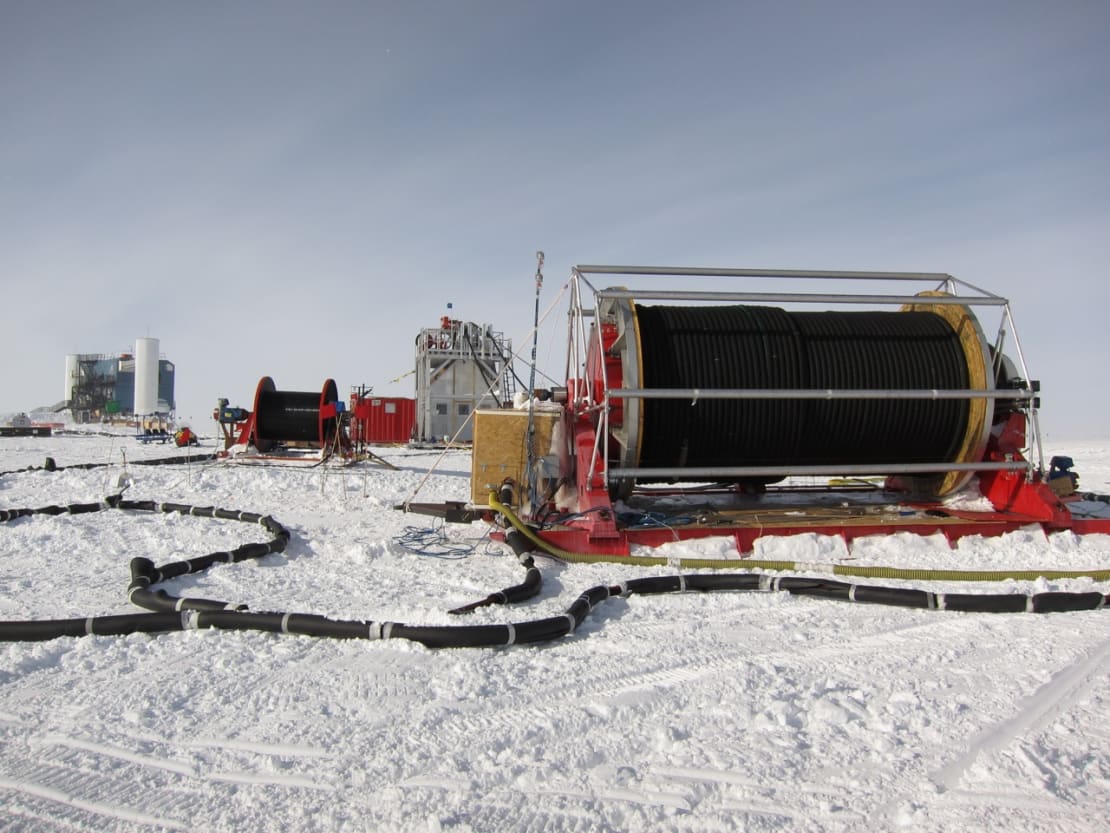
Since water starts to freeze immediately, IceCube sensors were quickly deployed following drilling. Once the refreezing process ended, which took a couple of weeks to stabilize, the failure rate of the instrumentation has been extremely low—fewer than 100 of the approximately 5,500 sensors are currently nonoperational.
IceCube sensors, designed with main contributions from Lawrence Berkeley National Laboratory, DESY-Zeuthen, and UW–Madison, were produced and tested at the universities in Stockholm and Uppsala in Sweden, DESY-Zeuthen in Germany, and the Physical Sciences Lab in Stoughton, Wisconsin, USA. Each string of sensors had a general theme, with a name given to each of the deployed sensors as a more effective means of identification rather than a numbering system.
Building IceCube was an extraordinary engineering achievement. It was completed on time, stayed within budget, and significantly exceeded performance specifications. This is a tribute to the perseverance and dedication of the physicists, engineers, and technicians that overcame the many challenges of creating and operating a detector in such an inhospitable environment.
The total cost of construction was $279 million. The National Science Foundation provided around $242 million with the remaining funds coming from funding agencies in the US and abroad.
- Digital Optical Modules (DOMs): IceCube uses over 5,000 optical sensors buried 1,450 to 2,450 meters deep in the Antarctic ice.
- Cherenkov Light: When neutrinos or cosmic-ray muons interact with the ice, they produce charged secondary particles that emit blue Cherenkov light.
- Time-Stamping: Each DOM digitizes the light signals and applies a high-precision time stamp (within 1–2 nanoseconds) before sending the data up to the surface. [1, 2, 3, 4, 5]
- IceCube Laboratory (ICL): Cables connect the DOMs to a central computer hub at the surface.
- Real-Time Filtering: The detector captures massive amounts of background noise—mostly cosmic-ray muons outnumbering neutrino events by roughly 500,000 to 1.
- Satellite Transfer: Because of satellite bandwidth limits, raw data is filtered locally. Only about 100 GB of prioritized data (out of roughly 1 TB generated daily) is sent via satellite to the Northern Hemisphere for full analysis. [1, 2, 3, 4]
- Reconstruction: Scientists convert light patterns into data revealing the direction, energy, and flavor of the incoming particles.
- Machine Learning: IceCube increasingly uses advanced tools like convolutional neural networks (CNNs) and transformer-based neural networks to speed up real-time event classification and directional estimation.
- IceProd and Distributed Computing: The collaboration uses IceProd, a Python-based distributed management system, along with high-throughput computing networks (such as HTCondor and the Center for High Throughput Computing) to run massive simulation and data-processing workloads across global computer clusters. [1, 2, 3, 4, 5, 6, 7]
- The ML Solution: By training Convolutional Neural Networks (CNNs) on millions of simulated data points, the network learns the physics of light propagation. [1, 2]
- The Impact: Once trained, these networks are computationally inexpensive and can reconstruct neutrino properties 100 to 1,000 times faster than standard algorithms, cutting processing times down to seconds. [1, 2]
- The Graph Approach: IceCube pioneered the open-source GraphNeT framework. This treats each sensor hit as a "node" on a graph connected to its neighbors. [1, 2]
- The Result: Graph Neural Networks (GNNs) excel at distinguishing the random background noise of dark current in the sensors from actual low-energy neutrino signals. They isolate true physics events with massive precision while executing over 10,000 times faster than older techniques. [1, 2]
- The Bottleneck: While "track" events (neutrinos that leave a long line of light) are easy to map quickly, "cascade" events (neutrinos that burst into a spherical shower of light) used to take too long to compute for real-time alerts.
- The ML Solution: IceCube introduced a two-tier neural network pipeline. The first network filters and separates atmospheric noise to isolate true astrophysical cascades with >85% purity. The second network calculates the precise direction and spatial uncertainty of the cascade event within seconds. This allows IceCube to broadcast Real-Time Alerts via NASA's GCN instantly. [1, 2]
- Transformers and Normalizing Flows: Mirroring architectures used in Large Language Models, IceCube employs transformer networks to treat photon data sequences like text. Combined with normalizing flows, these models can accurately calculate complex, non-spherical uncertainty regions on a 3D sphere, mapping a neutrino's source coordinates with unprecedented accuracy.
- Deep Learning Super-Resolution: Because the physical sensors are spaced far apart, the data can be "blurry". IceCube uses deep learning models to predict light patterns on imaginary, "virtual" optical sensors placed between the real ones. This upscales the resolution of the data event, dramatically improving angular precision. [1, 2, 3]
| Machine Learning Approach | Main Purpose | Core Advantage Over Traditional Physics Methods |
|---|---|---|
| Convolutional Neural Networks (CNNs) | High-speed reconstruction of particle energy and trajectory. | Reduces processing times from hours down to fractions of a second. |
| Graph Neural Networks (GNNs) | Cleaning noise and tracking low-energy particle events. | Correctly interprets irregular, sparse 3D geometry of the ice array 10,000x faster. |
| Transformers & Normalizing Flows | Modeling complex directional uncertainty boundaries. | Handles massive, multi-dimensional variables in detector and glacial ice traits. |
| Super-Resolution Networks | Synthesizing data for "virtual" sensors. | Artificially sharpens sparse sensor data to improve direction mapping. |


Không có nhận xét nào:
Đăng nhận xét